English is a mutt language. It seems like it just sort of *happened,* and all the logical and orthographical consistency & coherence to it is put and kept there by sheer force of will. (If we all close our eyes and imagine really hard that "i before e except after c" to be true, then perhaps it makes our language real and rational and not just a weird jumble of things people said and the eccentric ways they decided to spell them.
(Which then got arbitrarily made official and unchanging because we seem a lot cooler and more respectable if we have one solid thing that can be called a "language" and "nation" and "heritage" and such.
French conquerors, British barbarians, and an assortment of vikings all got together and babbled for a while, thus the European lovemass of linguistic incest spat out an under-developed latin/greek/germanic/celtic mass, which we've spent centuries polishing and putting in dictionaries.
This "mutt" quality becomes especially visible and remarkable when compared to Arabic. Good gosh does this language MAKE SENSE. It's a well-organized, supremely logical system, even with the thousands of years of colloquial wear and tear and the way the language is uncomfortably split between formal and street language. It's the foundations that matter -- and it has those! While English doesn't.
Every verb has a form and a shape and a root, and there aren't huge separate sets of vocabulary that seem to operate according to entirely different sets of rules (like Latin and Germanic stuff in English, for example.) Once you know how the system works, you can take any word apart and figure out what's going on, and sounding it out isn't a problem. (Unlike though and enough, for example.)
It's kind of refreshing actually. But at the same time, this doesn't mean I prefer it, or that if I could've chosen my native language I'd have picked the admirably logical and consistent Arabic. Not at all. (For one thing, the radical split between formal and colloquial language (they're essentially two different languages) does horrible things for a culture of reading.) (Imagine having to look really really hard to find a single modern novel or poem that wasn't essentially written in Shakespeare-speak.)
I enjoy and am amazed by the profound depth, beauty, and coherence of the system of the Arabic language, but the primary reason I much prefer English -- and am deeply glad that this is the language my brain was raised in & through is because of that "mutt" quality. For one thing, I think that chaotic mass of mixed traditions and cultures and irrational ways of spelling is a much truer vision of the world. We impose our own order.
Thus as a language and thus as a way of thinking and being
in the world (cause pretty much all of my conscious thoughts and words
are filtered through this language), it's helpful for adapting -- and
it's also a heck of a lot more fun.
And while it might be easier to think of a purebred, consistent system like Arabic as being "beautiful" in a way, and it is, I think that mixed, chaotic, perhaps even broken systems like English are beautiful in perhaps an even more profound way. I think in a very clearly *human* way as well.
In English it's clear to see that there is a long tradition of doing w/e the heck you want, saying and writing things however feels right or seems appropriate or hilarious in the moment. Have fun with it. That history of language fun and language experimentation is an inspiring reminder to not get hung up on comma use or spelling.
Arabic grammar nazis have some good arguments. They've got something solid to stand for and on. English grammar nazis? Don't make me laugh.
Saturday, June 6, 2015


Wednesday, May 20, 2015
An Average Wednesday in the Holy City
Instant news updates are helpful in a city that has lots of regular instant news events to keep track of, but I rely fully on wifi, so I got both of these (roughly equivalent) headline notifications hours after they would've been any use at all to me.


On a directly related note, I was two and a half hours late to work today! I got to take a longer bus ride than normal, walk a ways, take another taxi, and then get a ride from a Kindergarten parent.
Here's why: Maan News (the English one of the two notification headlines circled above) (Disclaimer: I was never personally in any danger whatsoever, it's just that them soldiers got roadblocks fo' days, and I happened to be stuck behind them.)
For an interesting comparison, symptomatic of a whole bushel of things, here's a popular Israeli paper's take on the incident from Israel Hayom. (counter-balancing the Arab news agency)
(Also Israel Hayom is a freely distributed newspaper everywhere in Israel cause American billionaire Sheldon Adelson basically pays for the whole thing. Another claim to fame might be that he spent $150 million on Mitt Romney's campaign in 2012.)
And for my take on the incident itself, here's a little context for fairness:
1) Israeli citizens have been intentionally targeted in vehicle hit-and-run attacks before.
2) Israeli soldiers/police officers have shot and killed innocent Palestinians for far less suspicious behavior (erratic driving & attempted U-Turns included)
3) I'm sure that the police officers 100% legitimately were afraid for their lives. But does being afraid, whether rationally or irrationally, always justify retaliation? (And we can up the ante in a very relevant way by rephrasing that as "But does being afraid, whether completely rationally or supremely irrationally, always justify immediate and lethal retaliation?" Given it's kind of hard to pick apart that rational v. irrational fear thing, and that's true throughout the Israeli/Palestinian context.
(Also I think this question of fear as a justification for immediately shooting a sucka down is perhaps relevant to the discussion of police violence in Amurka as well maybe?)
And for those who aren't on Facebook (and thus saw this already), this also happened today:
(Start reading from the bottom cause that's chronological cause that's how notifications work)

I giggled.

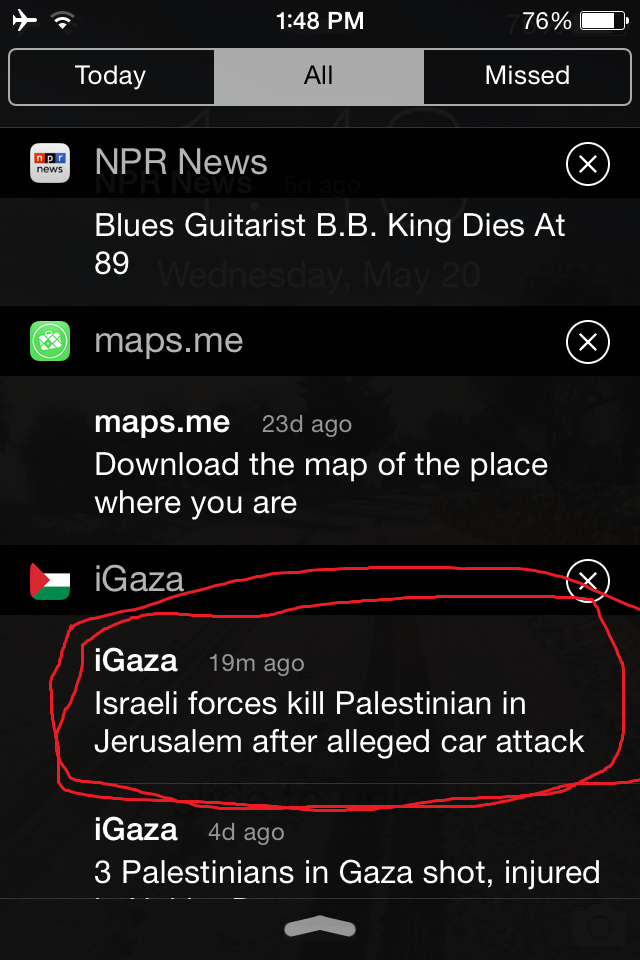
On a directly related note, I was two and a half hours late to work today! I got to take a longer bus ride than normal, walk a ways, take another taxi, and then get a ride from a Kindergarten parent.
Here's why: Maan News (the English one of the two notification headlines circled above) (Disclaimer: I was never personally in any danger whatsoever, it's just that them soldiers got roadblocks fo' days, and I happened to be stuck behind them.)
For an interesting comparison, symptomatic of a whole bushel of things, here's a popular Israeli paper's take on the incident from Israel Hayom. (counter-balancing the Arab news agency)
(Also Israel Hayom is a freely distributed newspaper everywhere in Israel cause American billionaire Sheldon Adelson basically pays for the whole thing. Another claim to fame might be that he spent $150 million on Mitt Romney's campaign in 2012.)
And for my take on the incident itself, here's a little context for fairness:
1) Israeli citizens have been intentionally targeted in vehicle hit-and-run attacks before.
2) Israeli soldiers/police officers have shot and killed innocent Palestinians for far less suspicious behavior (erratic driving & attempted U-Turns included)
3) I'm sure that the police officers 100% legitimately were afraid for their lives. But does being afraid, whether rationally or irrationally, always justify retaliation? (And we can up the ante in a very relevant way by rephrasing that as "But does being afraid, whether completely rationally or supremely irrationally, always justify immediate and lethal retaliation?" Given it's kind of hard to pick apart that rational v. irrational fear thing, and that's true throughout the Israeli/Palestinian context.
(Also I think this question of fear as a justification for immediately shooting a sucka down is perhaps relevant to the discussion of police violence in Amurka as well maybe?)
And for those who aren't on Facebook (and thus saw this already), this also happened today:
(Start reading from the bottom cause that's chronological cause that's how notifications work)

I giggled.
Tuesday, May 19, 2015
I Wonder What Middle-Eastern Listservs Look Like...
It's been a supremely long and full year so far -- and by that I don't just mean spiritually, emotionally, physically, schedule-wise, and in terms of having sufficient mental capacity for fully processing experiences-wise. But email-wise as well.
Even my gmail inbox has not been free from the enormous figurative scale of this year and the massive amounts of ideas, content, figurative clutter and political noise and controveries that have been constant fixtures of my life here.
So just to give you a taste of what my gmail's life has been like this year, here's an assortment of various listservs and auto-group-distribution type things I've found myself on the receiving end of this year.
(This isn't a particulary content-ful blog post, BUT, hopefully it's still a little interesting, and it might be an opportunity for you to follow some of these links and check out a Middle Eastern listserv for yourself! Or just look around their websites to see what they do.)
(All of these below I get some sort of at least vaguely regular email contact from. Also I'm fans of many of them on Facebook, which means I see their stuff there too!)
Al-Monitor: Excellent, reliable political coverage from local correspondents throughout the Middle East. I get daily briefings/collections of headlines from them.
A billion YAGM newsletters from all over the world: It'd be kind of ridiculous and irresponsible to put all their email addresses up here, but it is possible for you to join these mailing lists! Look for them, or just ask me to help you if you're that interested. Also here's a link to other YAGM volunteer blogs.
Religion & Ethics Newsweekly
Churches for Middle East Peace Sends out briefings every couple of weeks with the major news updates on the general Israel/Palestine context. Good way of keeping up-to-date with the basics, and there's good resources on their site too. Also it's an organization made up of American churches working for "Middle East Peace," so that's cool, and provides easy opportunities for getting involved, advocacy/activism-wise.
B'Tselem (occasional e-newsletter) B'Tselem is a prominent Israeli organization that monitors human rights abuses in Israel's occupied territories. (East Jerusalem, the West Bank, Gaza) Lots and lots of good internet resources too.
Combatants for Peace Organization of militants from both sides of the conflict who've come together to advocate for peace and an end to endless cycles of violence and occupation. They send me something every now and then about events they're planning.
Breaking the Silence: Organization made up of Israeli soldiers who, after finishing their military service, decided to speak out about the things they saw and participated in. They do a lot of education and tours and such, and you can find many testimonials from individual soldiers on their site. Their newsletters are just updates on what the organization has been doing from month to month. (They also released a large report on testimonials from soldiers who were in Gaza last summer.)
Kids4Peace: This organization gets kids together of all three Abrahamic faiths, from all across the political, racial, and socio-economic spectrums here in Israel/Palestine, and they go through a 6-year program of dialogue, co-existence, peacemaking skills, etc., and they spend a lot of time with youth in America too. I blog for them occasionally and I get cool newsletter updates.
Emek Shaveh: Emek Shaveh is an organization of Israeli archaeologists fighting against the way the Israeli establishment uses archaeology as a political tool to aid in the continuing confiscation of Palestinian land and the slow expulsion of Palestinians themselves that goes along with that.
Wadi Hilweh Information Center: One of the biggest current arenas of this politically-charged archaeology/confiscation/expulsion thing is the Palestinian neighborhood of Silwan in Jerusalem. (Emek Shaveh has a lot of good information on this too.) The Wadi Hilweh Information Center is the outreach and education wing of the local Palestinian community center in Silwan. (Here's the main community center page although I don't think I get any emails from them.)
Zochrot: Zochrot is an Israeli NGO that works generally in outreach and education to raise awareness of the Palestinian Nakba in Israeli society. The Nakba ("catastrophe" in Arabic) refers to the massive displacement and expulsion of hundreds of thousands of Palestinians and the destruction of their villages in 1948 when the state of Israel was established. (The existence of this event and its legitimacy is not usually recognized by any governmental Israeli organization, and many many Israelis are similarly unaware or critical of it.)
Tourist Israel: The events and tours it talks about are usually way too expensive for me and my volunteer stipend, but this organization is about exactly what it sounds like.
CJS Tours: The Palestinian Center for Jerusalem Studies does cool educational tours on the many complicated layers of history in the Old City and Jerusalem! Attached to Al-Quds University. (Al-Quds is what Jerusalem is called in Arabic. Literally means "The Holy," but is short for "The Holy City."
Shutterfly: Seems silly to link to this. We have a fancy photo site for pictures of the kids in the kindergarten, but it's private, so if you want pictures of the kids make sure you're on my newsletter list! More of that coming soon.
Redeemer Lutheran Church: Arabic (daily) & English (weekly) newsletters: Oh my gosh I'm running out of steam so fast. Ask me if you're interested in these. (You can also sign up for regular (I think quarterly?) updates on the English congregation and local goings-on, specifically for people who actually don't currently live here.)
Haaretz popular Israeli newspaper
Yabous Cultural Center
Educational Bookshop in Jerusalem
The Lutheran Magazine
Tantur Institute Notre Dame satellite ecumenical center in East Jerusalem
Oud for Guitarists
Interfaith Encounter Association
The Parents Circle: Bereaved Family Forum
Rabbis For Human Rights
Palestine-Israel Journal of Politics, Economics and Culture
The East Jerusalem French Institute
Search for Common Ground
(And this was just listservs, mass e-communication. The interpersonal communication here has gotten complicated over time for a somewhat different reason -- namely that whole "language" thing. By which I mean "Arabic," because neither my spoken nor my written ability in Hebrew is beyond the please/thank you courtesies and the occasional "shalom" salutation tag at the end of emails/postcards. But for Arabic I end up having to switch to my phone whenever I want to draft an email or respond to someone on Facebook who doesn't speak English.)
Cause while I *can* type Arabic letters on my computer keyboard, it's not a fun time. (It involves a lot of guess-work, you might call it trial-and-error word-processing.) For younger people there's a whole common internet e-slang style of writing Arabic with non-Arabic letters, but that gives me a massive headache. So instead I downloaded an Arabic keyboard on my phone.
Even my gmail inbox has not been free from the enormous figurative scale of this year and the massive amounts of ideas, content, figurative clutter and political noise and controveries that have been constant fixtures of my life here.
So just to give you a taste of what my gmail's life has been like this year, here's an assortment of various listservs and auto-group-distribution type things I've found myself on the receiving end of this year.
(This isn't a particulary content-ful blog post, BUT, hopefully it's still a little interesting, and it might be an opportunity for you to follow some of these links and check out a Middle Eastern listserv for yourself! Or just look around their websites to see what they do.)
(All of these below I get some sort of at least vaguely regular email contact from. Also I'm fans of many of them on Facebook, which means I see their stuff there too!)
Al-Monitor: Excellent, reliable political coverage from local correspondents throughout the Middle East. I get daily briefings/collections of headlines from them.
A billion YAGM newsletters from all over the world: It'd be kind of ridiculous and irresponsible to put all their email addresses up here, but it is possible for you to join these mailing lists! Look for them, or just ask me to help you if you're that interested. Also here's a link to other YAGM volunteer blogs.
Religion & Ethics Newsweekly
Churches for Middle East Peace Sends out briefings every couple of weeks with the major news updates on the general Israel/Palestine context. Good way of keeping up-to-date with the basics, and there's good resources on their site too. Also it's an organization made up of American churches working for "Middle East Peace," so that's cool, and provides easy opportunities for getting involved, advocacy/activism-wise.
B'Tselem (occasional e-newsletter) B'Tselem is a prominent Israeli organization that monitors human rights abuses in Israel's occupied territories. (East Jerusalem, the West Bank, Gaza) Lots and lots of good internet resources too.
Combatants for Peace Organization of militants from both sides of the conflict who've come together to advocate for peace and an end to endless cycles of violence and occupation. They send me something every now and then about events they're planning.
Breaking the Silence: Organization made up of Israeli soldiers who, after finishing their military service, decided to speak out about the things they saw and participated in. They do a lot of education and tours and such, and you can find many testimonials from individual soldiers on their site. Their newsletters are just updates on what the organization has been doing from month to month. (They also released a large report on testimonials from soldiers who were in Gaza last summer.)
Kids4Peace: This organization gets kids together of all three Abrahamic faiths, from all across the political, racial, and socio-economic spectrums here in Israel/Palestine, and they go through a 6-year program of dialogue, co-existence, peacemaking skills, etc., and they spend a lot of time with youth in America too. I blog for them occasionally and I get cool newsletter updates.
Emek Shaveh: Emek Shaveh is an organization of Israeli archaeologists fighting against the way the Israeli establishment uses archaeology as a political tool to aid in the continuing confiscation of Palestinian land and the slow expulsion of Palestinians themselves that goes along with that.
Wadi Hilweh Information Center: One of the biggest current arenas of this politically-charged archaeology/confiscation/expulsion thing is the Palestinian neighborhood of Silwan in Jerusalem. (Emek Shaveh has a lot of good information on this too.) The Wadi Hilweh Information Center is the outreach and education wing of the local Palestinian community center in Silwan. (Here's the main community center page although I don't think I get any emails from them.)
Zochrot: Zochrot is an Israeli NGO that works generally in outreach and education to raise awareness of the Palestinian Nakba in Israeli society. The Nakba ("catastrophe" in Arabic) refers to the massive displacement and expulsion of hundreds of thousands of Palestinians and the destruction of their villages in 1948 when the state of Israel was established. (The existence of this event and its legitimacy is not usually recognized by any governmental Israeli organization, and many many Israelis are similarly unaware or critical of it.)
Tourist Israel: The events and tours it talks about are usually way too expensive for me and my volunteer stipend, but this organization is about exactly what it sounds like.
CJS Tours: The Palestinian Center for Jerusalem Studies does cool educational tours on the many complicated layers of history in the Old City and Jerusalem! Attached to Al-Quds University. (Al-Quds is what Jerusalem is called in Arabic. Literally means "The Holy," but is short for "The Holy City."
Shutterfly: Seems silly to link to this. We have a fancy photo site for pictures of the kids in the kindergarten, but it's private, so if you want pictures of the kids make sure you're on my newsletter list! More of that coming soon.
Redeemer Lutheran Church: Arabic (daily) & English (weekly) newsletters: Oh my gosh I'm running out of steam so fast. Ask me if you're interested in these. (You can also sign up for regular (I think quarterly?) updates on the English congregation and local goings-on, specifically for people who actually don't currently live here.)
Haaretz popular Israeli newspaper
Yabous Cultural Center
Educational Bookshop in Jerusalem
The Lutheran Magazine
Tantur Institute Notre Dame satellite ecumenical center in East Jerusalem
Oud for Guitarists
Interfaith Encounter Association
The Parents Circle: Bereaved Family Forum
Rabbis For Human Rights
Palestine-Israel Journal of Politics, Economics and Culture
The East Jerusalem French Institute
Search for Common Ground
(And this was just listservs, mass e-communication. The interpersonal communication here has gotten complicated over time for a somewhat different reason -- namely that whole "language" thing. By which I mean "Arabic," because neither my spoken nor my written ability in Hebrew is beyond the please/thank you courtesies and the occasional "shalom" salutation tag at the end of emails/postcards. But for Arabic I end up having to switch to my phone whenever I want to draft an email or respond to someone on Facebook who doesn't speak English.)
Cause while I *can* type Arabic letters on my computer keyboard, it's not a fun time. (It involves a lot of guess-work, you might call it trial-and-error word-processing.) For younger people there's a whole common internet e-slang style of writing Arabic with non-Arabic letters, but that gives me a massive headache. So instead I downloaded an Arabic keyboard on my phone.
Saturday, May 16, 2015
The Holy City of a Thousand Requisite Dietary Restrictions for the Purpose of Maintaining Holiness
The biggest mistake I made this year?
I ordered oatmeal during Passover (a week in early April) -- specifically at an Israeli cafe.
The cashier grabbed a nearby staff person and urgently whispered in Hebrew. The other guy shrugged. I imagine the exchange went something like this:
1: Dude. This guy just asked for oatmeal. Like... what do I do.
2: What?? Does he have any idea what he's doing?
1: Probably not, but it'd be really stressful to try to explain the problem in English. I don't know how to say "unleavened bread," and I can't even begin to explain the whole "grain products that are fermented or can cause fermentation" subclause. And the lines way too long for this to become a whole lecture on Jewish life and customs anyway.
2: Yeah whatever. But wait? How do you even *make* oatmeal that's Passover-kosher? Like, what is it?
1: No idea. Get creative I guess.
2: Aye aye captain.
All they did towards me was smile and ask for my money, and I wasn't awake or alert enough to wonder about the whispers at the time. I was just an unsuspecting victim -- until the oatmeal actually arrived. And even then, things took some time to finally become clear.
My first clue that something was wrong was the thick blanket of what looked to be sesame seeds -- apparently the closest thing to oats that didn't get cleaned out in the intensive pre-Passover kitchen scouring and scrubbing. (Which is a real and really incredibly intensive process -- it's been described to me as the prototypical spring cleaning, except instead of dust, mildew, mold and clutter, the targets are every crumb, speck and residue of leaven/yeast, which often entails pretty much boiling every thing you can figure out how to boil (kitchen utensils, counters, microwaves, etc.))
There was yogurt in the "oatmeal" too, so that was ok. And there was fruit too, although not especially fresh or varied (I don't know if stale, dry cantaloupe can be successfully blamed on the annual ritualized celebration of the Jews' escape from slavery in Egypt).
But those portions of the dish were sort of enlarged to make up for the total absence of "oatmeal" as such, and then liberally sprinkled with various ingredients that might've been thought to appease me in the oatmeal's absence. Thus, sesame seeds, unidentifiable nuts, etc.
I'm sort of stuck between the majority Jewish country of Israel and the majority Muslim country of Palestine (in the murky, magical but horribly tense liminal in-between zone of East Jerusalem), so unusual (for me) dietary restrictions have become a regular thing.
It means cheeseburgers are a rarity in Israeli areas (Kosher here often means separate restaurants entirely for dairy and meat.) Or in the best case scenario, you need a friendly non-Jewish McDonald's cashier to secretly slip you a slice of cheese under the table, and then you have to finish your meal and come order again to get the milkshake. (Sometimes you have to go find a milkshake place next door.)
It means sushi -- when you can find it -- is almost always fully cooked, never raw.
It means if you want alcohol and you're in an Arab-Palestinian area, you have to hunt down the one Christian grocery store in the whole neighborhood. Or settle for "Bavaria." (A popular non-alcoholic malt beverage: available in a wide range of "flavors," including: Apple, Peach, Ivory, Raspberry, and Premium.)
And for pork you probably have to call ahead from an undisclosed location and then "accidentally" stumble into a Christian butcher shop in Palestine or a Russian supermarket in Israel -- both of which might likely have to import or special order from a few fancy domestic pork farms where the pigs are kept on weird rabbinically-approved platforms that keep the pigs from ever touching the ground.
You also have to know the days to not be eating or drinking or driving a car or various things in public in certain neighborhoods. Yom Kippur and weekly shabat in the religious Jewish neighborhoods, and Ramadan in Muslim neighborhoods (Actual restrictions differ for each of these three times, not necessarily all three of those forbidden things listed above). Mostly cause you'll just really irritate people and be insanely disrespectful as you do, but ultra-orthodox Jewish neighborhoods might throw rocks at you if you drive there on shabat (or at the very least they'll just scream angrily.) And rocks are a given on Yom Kippur.
Some of the more Orthodox Christian groups have some restrictions too, including some fasting & required vegetarian-ness during Lent and whatnot, but some of the more western-based Christian sects sort of just mind their own business when it comes to dietary restrictions. "Moderation," and whatnot perhaps.
As an outsider here, who definitely comes more out of that western "ehhh... eat what you like," tradition -- (Unless you count the ethical strictures of animal rights groups or the "nutritional science establishment" and their do's and don't's as modern western dietary traditions. Which maybe we should count those? Although when it comes to those I'm still pretty "non-observant," and while I try to keep those things in mind, I don't really follow them "religiously," per se.) ha.
But yeah. As an outsider here, my first instinct might be like, "Well that's weird. I just want a bacon cheeseburger, is that really too much to ask?" (quite often it is.)
But it's been really worthwhile to get to know and develop a respect for these traditional dietary regimens, or whatever you want to call them. Eschewing the boundaries and just saying "we in the west use the enlightened path of 'moderation' instead of primitive food taboos" is one thing -- but I have serious doubts about how well we follow that path of "moderation" when it comes to reality.
And perhaps "moderation," -- if it's the ideal that we're replacing these restrictions with -- and probably failing to live up to -- then the term should refer not only to what we specifically put in our body and how much of it, but how much our society invests in and does or doesn't take care of the environment/world/creation from which we draw these resources.
And maybe, like I mentioned before, the real replacement for these codified group dietary restrictions in our society isn't "independent individuals engaging in moderation," but "MAKE SURE YOU EAT SUPERFRUITS," and "ONE GLASS OF RED WINE EVERY EVENING" and "CAREFULLY POLICE THE BORDERS OF YOUR STOMACH FOR PROPER SODIUM INTAKE, THESE ARE THE SKILLED EDUCATED FAT DEMOGRAPHICS WE WANT AND THESE ARE THE FATS WE DON'T WANT, THESE ARE THE POLITICAL REFUGEE CHOLESTOROL(S) WE WANT AND THESE ARE THE UNSAVORY CHOLESTOROL(S) WITH NOWHERE ELSE TO GO THAT WE SHOULD JUST LEAVE FOR OTHERS TO CLAIM."
P.S. Olive oil is way better than butter in pretty much every way. Go Mediterranean, make the switch, never look back.
P.P.S. That got weird at the end there -- not really sure what happened.
P.P.P.S. I blame the sudden change in diet. Food does weird stuff to you. Nutrition is important.
I ordered oatmeal during Passover (a week in early April) -- specifically at an Israeli cafe.
The cashier grabbed a nearby staff person and urgently whispered in Hebrew. The other guy shrugged. I imagine the exchange went something like this:
1: Dude. This guy just asked for oatmeal. Like... what do I do.
2: What?? Does he have any idea what he's doing?
1: Probably not, but it'd be really stressful to try to explain the problem in English. I don't know how to say "unleavened bread," and I can't even begin to explain the whole "grain products that are fermented or can cause fermentation" subclause. And the lines way too long for this to become a whole lecture on Jewish life and customs anyway.
2: Yeah whatever. But wait? How do you even *make* oatmeal that's Passover-kosher? Like, what is it?
1: No idea. Get creative I guess.
2: Aye aye captain.
All they did towards me was smile and ask for my money, and I wasn't awake or alert enough to wonder about the whispers at the time. I was just an unsuspecting victim -- until the oatmeal actually arrived. And even then, things took some time to finally become clear.
My first clue that something was wrong was the thick blanket of what looked to be sesame seeds -- apparently the closest thing to oats that didn't get cleaned out in the intensive pre-Passover kitchen scouring and scrubbing. (Which is a real and really incredibly intensive process -- it's been described to me as the prototypical spring cleaning, except instead of dust, mildew, mold and clutter, the targets are every crumb, speck and residue of leaven/yeast, which often entails pretty much boiling every thing you can figure out how to boil (kitchen utensils, counters, microwaves, etc.))
There was yogurt in the "oatmeal" too, so that was ok. And there was fruit too, although not especially fresh or varied (I don't know if stale, dry cantaloupe can be successfully blamed on the annual ritualized celebration of the Jews' escape from slavery in Egypt).
But those portions of the dish were sort of enlarged to make up for the total absence of "oatmeal" as such, and then liberally sprinkled with various ingredients that might've been thought to appease me in the oatmeal's absence. Thus, sesame seeds, unidentifiable nuts, etc.
----------------------------------------
It means cheeseburgers are a rarity in Israeli areas (Kosher here often means separate restaurants entirely for dairy and meat.) Or in the best case scenario, you need a friendly non-Jewish McDonald's cashier to secretly slip you a slice of cheese under the table, and then you have to finish your meal and come order again to get the milkshake. (Sometimes you have to go find a milkshake place next door.)
It means sushi -- when you can find it -- is almost always fully cooked, never raw.
It means if you want alcohol and you're in an Arab-Palestinian area, you have to hunt down the one Christian grocery store in the whole neighborhood. Or settle for "Bavaria." (A popular non-alcoholic malt beverage: available in a wide range of "flavors," including: Apple, Peach, Ivory, Raspberry, and Premium.)
And for pork you probably have to call ahead from an undisclosed location and then "accidentally" stumble into a Christian butcher shop in Palestine or a Russian supermarket in Israel -- both of which might likely have to import or special order from a few fancy domestic pork farms where the pigs are kept on weird rabbinically-approved platforms that keep the pigs from ever touching the ground.
You also have to know the days to not be eating or drinking or driving a car or various things in public in certain neighborhoods. Yom Kippur and weekly shabat in the religious Jewish neighborhoods, and Ramadan in Muslim neighborhoods (Actual restrictions differ for each of these three times, not necessarily all three of those forbidden things listed above). Mostly cause you'll just really irritate people and be insanely disrespectful as you do, but ultra-orthodox Jewish neighborhoods might throw rocks at you if you drive there on shabat (or at the very least they'll just scream angrily.) And rocks are a given on Yom Kippur.
Some of the more Orthodox Christian groups have some restrictions too, including some fasting & required vegetarian-ness during Lent and whatnot, but some of the more western-based Christian sects sort of just mind their own business when it comes to dietary restrictions. "Moderation," and whatnot perhaps.
---------------------------------------
As an outsider here, who definitely comes more out of that western "ehhh... eat what you like," tradition -- (Unless you count the ethical strictures of animal rights groups or the "nutritional science establishment" and their do's and don't's as modern western dietary traditions. Which maybe we should count those? Although when it comes to those I'm still pretty "non-observant," and while I try to keep those things in mind, I don't really follow them "religiously," per se.) ha.
But yeah. As an outsider here, my first instinct might be like, "Well that's weird. I just want a bacon cheeseburger, is that really too much to ask?" (quite often it is.)
But it's been really worthwhile to get to know and develop a respect for these traditional dietary regimens, or whatever you want to call them. Eschewing the boundaries and just saying "we in the west use the enlightened path of 'moderation' instead of primitive food taboos" is one thing -- but I have serious doubts about how well we follow that path of "moderation" when it comes to reality.
And perhaps "moderation," -- if it's the ideal that we're replacing these restrictions with -- and probably failing to live up to -- then the term should refer not only to what we specifically put in our body and how much of it, but how much our society invests in and does or doesn't take care of the environment/world/creation from which we draw these resources.
And maybe, like I mentioned before, the real replacement for these codified group dietary restrictions in our society isn't "independent individuals engaging in moderation," but "MAKE SURE YOU EAT SUPERFRUITS," and "ONE GLASS OF RED WINE EVERY EVENING" and "CAREFULLY POLICE THE BORDERS OF YOUR STOMACH FOR PROPER SODIUM INTAKE, THESE ARE THE SKILLED EDUCATED FAT DEMOGRAPHICS WE WANT AND THESE ARE THE FATS WE DON'T WANT, THESE ARE THE POLITICAL REFUGEE CHOLESTOROL(S) WE WANT AND THESE ARE THE UNSAVORY CHOLESTOROL(S) WITH NOWHERE ELSE TO GO THAT WE SHOULD JUST LEAVE FOR OTHERS TO CLAIM."
P.S. Olive oil is way better than butter in pretty much every way. Go Mediterranean, make the switch, never look back.
P.P.S. That got weird at the end there -- not really sure what happened.
P.P.P.S. I blame the sudden change in diet. Food does weird stuff to you. Nutrition is important.
Sunday, May 3, 2015
Popsicles, games, cheers, and letting kids be kids (link and re-post)
(This blog post was originally posted on the Kids4Peace official blog -- this is an official re-post. The original one has pictures so it's better.)
There's nothing so simple and joyful as just watching kids at play. You give them the space to run and jump and laugh and express themselves, and everything else seems to just fall away. But sometimes it's not as simple as it seems.
On Friday, April 17th, I spent the day with the 66 newest members of Kids4Peace -- the latest crop of 6th-graders that just started this January. It was field day at the Beit Safafa School in East Jerusalem, and that meant a day of popsicles, games, cheers, and letting kids be kids.
And that's what they did. At first glance (or at first listen -- as you approach the school playground from a distance and hear only the giggles and shouts as they drift out into the famously resonant and echo-friendly city of Jerusalem), it was indistinguishable from any other group of 6th-graders discovering lacrosse for the first time or getting into a game of tug-of-war.
But this was so much more than that. For one thing, it was the start of a six-year journey with Kids4Peace.
These kids are evenly split between the three Abrahamic religions that call Jerusalem home. Judaism, Islam, and Christianity, and even within those categories there's remarkable diversity: Palestinian, Israeli, European, Arab, religious, secular, wealthy, poor, and all the seemingly endless ways each of those identifiers can mix and match and combine to form fascinatingly different but uniformly adorable and engaging children.
All of that plus the occasional language barrier means there's still some awkwardness and clumping. The social circles that form organically when the kids sit down on the pavement for lunch aren't exactly fully inclusive -- and if you're watching closely you'll notice that "random selection" when picking teams for baseball often leaves the sides suspiciously unbalanced.
But you can't expect 6th-graders not to *cheat* a little bit to be on the same team as their friends. And -- in true 6th-grade fashion -- these self-selected teams and lunch groups were divided by gender far more often than by anything else. (Especially considering that, without the occasional hijab or crucifix-necklace or kippah, the non-gender based differences can be a lot harder to spot.)
At this point, when the kids are still wearing nametags, when they're still struggling to find the best, most comfortable ways to communicate somewhere in the chaotic mix of Hebrew, Arabic, and English -- it's hard to imagine that these kids really know what is in store for them.
Sixth grade means 11 or 12 years old. They're teetering on the edge of the "kid world" that dominates in elementary school, beginning to drift dangerously into the emotional, socially-stratified world that follows, populated by teenagers and adolescence.
As if middle school wasn't enough, these kids have the troubled world around them to contend with as well. They haven't necessarily fully come to terms yet with what the Israeli-Palestinian context will do to shape their lives, and they surely have no idea what the next six years in Kids4Peace might mean for them.
There will be powerful friendships, challenging emotions, painful dialogues, and difficult but ultimately worthwhile coexistence -- and who knows what else. But for now there is play.
One of the four stations of the day is for assorted silly games, especially ones that require a lot of running. Tug-of-war is a big hit, although it leaves some guys a little shamed and disappointed. (The girls crush them every chance they get, while the boys sit idly by and wait for their own growth spurts.)
At another station the kids learn the traditional Kids4Peace cheers, shouting their way through them alternately in English, Arabic, and Hebrew. As the years continue, this cheer will become more and more significant and unavoidably loaded with emotion and energy of one kind or another -- but for now it seems like little more than a mildly amusing chore. One boy laughs as he helps lead another round through the chant, but then wraps his arm around his buddy and remarks loudly, "I'm not having fun!"
Only an hour later, however, the boy is running bases in his first experience of Baseball. "This is the best game ever!" he exclaims to no one in particular as he lands on second.
The last two situations are thus reserved for Baseball and Lacrosse -- two pure American imports that produce some funny looks on kids' faces, sometimes amused, sometimes frustrated, sometimes just confused. But there is no "This is stupid," or "I don't get it." They dive in, joyfully and eagerly getting into something new. They do some quick training as the volunteers from the Baseball and Lacrosse organizations show them the basic skills and rules, and the game is on.
The newness of the sports means no child is an expert. Even if they've seen it on TV before, most kids have probably never swung a bat. Everyone feels a bit silly, and maybe the slightest bit uncomfortable as they get used to swinging this weird Lacrosse stick around -- but they're learning together, and that's what this is all about.
http://k4pblog.org/2015/04/20/popsicles-games-cheers-and-letting-kids-be-kids/
There's nothing so simple and joyful as just watching kids at play. You give them the space to run and jump and laugh and express themselves, and everything else seems to just fall away. But sometimes it's not as simple as it seems.
On Friday, April 17th, I spent the day with the 66 newest members of Kids4Peace -- the latest crop of 6th-graders that just started this January. It was field day at the Beit Safafa School in East Jerusalem, and that meant a day of popsicles, games, cheers, and letting kids be kids.
And that's what they did. At first glance (or at first listen -- as you approach the school playground from a distance and hear only the giggles and shouts as they drift out into the famously resonant and echo-friendly city of Jerusalem), it was indistinguishable from any other group of 6th-graders discovering lacrosse for the first time or getting into a game of tug-of-war.
But this was so much more than that. For one thing, it was the start of a six-year journey with Kids4Peace.
These kids are evenly split between the three Abrahamic religions that call Jerusalem home. Judaism, Islam, and Christianity, and even within those categories there's remarkable diversity: Palestinian, Israeli, European, Arab, religious, secular, wealthy, poor, and all the seemingly endless ways each of those identifiers can mix and match and combine to form fascinatingly different but uniformly adorable and engaging children.
All of that plus the occasional language barrier means there's still some awkwardness and clumping. The social circles that form organically when the kids sit down on the pavement for lunch aren't exactly fully inclusive -- and if you're watching closely you'll notice that "random selection" when picking teams for baseball often leaves the sides suspiciously unbalanced.
But you can't expect 6th-graders not to *cheat* a little bit to be on the same team as their friends. And -- in true 6th-grade fashion -- these self-selected teams and lunch groups were divided by gender far more often than by anything else. (Especially considering that, without the occasional hijab or crucifix-necklace or kippah, the non-gender based differences can be a lot harder to spot.)
At this point, when the kids are still wearing nametags, when they're still struggling to find the best, most comfortable ways to communicate somewhere in the chaotic mix of Hebrew, Arabic, and English -- it's hard to imagine that these kids really know what is in store for them.
Sixth grade means 11 or 12 years old. They're teetering on the edge of the "kid world" that dominates in elementary school, beginning to drift dangerously into the emotional, socially-stratified world that follows, populated by teenagers and adolescence.
As if middle school wasn't enough, these kids have the troubled world around them to contend with as well. They haven't necessarily fully come to terms yet with what the Israeli-Palestinian context will do to shape their lives, and they surely have no idea what the next six years in Kids4Peace might mean for them.
There will be powerful friendships, challenging emotions, painful dialogues, and difficult but ultimately worthwhile coexistence -- and who knows what else. But for now there is play.
One of the four stations of the day is for assorted silly games, especially ones that require a lot of running. Tug-of-war is a big hit, although it leaves some guys a little shamed and disappointed. (The girls crush them every chance they get, while the boys sit idly by and wait for their own growth spurts.)
At another station the kids learn the traditional Kids4Peace cheers, shouting their way through them alternately in English, Arabic, and Hebrew. As the years continue, this cheer will become more and more significant and unavoidably loaded with emotion and energy of one kind or another -- but for now it seems like little more than a mildly amusing chore. One boy laughs as he helps lead another round through the chant, but then wraps his arm around his buddy and remarks loudly, "I'm not having fun!"
Only an hour later, however, the boy is running bases in his first experience of Baseball. "This is the best game ever!" he exclaims to no one in particular as he lands on second.
The last two situations are thus reserved for Baseball and Lacrosse -- two pure American imports that produce some funny looks on kids' faces, sometimes amused, sometimes frustrated, sometimes just confused. But there is no "This is stupid," or "I don't get it." They dive in, joyfully and eagerly getting into something new. They do some quick training as the volunteers from the Baseball and Lacrosse organizations show them the basic skills and rules, and the game is on.
The newness of the sports means no child is an expert. Even if they've seen it on TV before, most kids have probably never swung a bat. Everyone feels a bit silly, and maybe the slightest bit uncomfortable as they get used to swinging this weird Lacrosse stick around -- but they're learning together, and that's what this is all about.
"Everywhere we go (echo)
People want to know (echo)
Who we are (echo)
So we tell them (echo)
We are Kids4Peace
Mighty Mighty Kids4Peace
Tired of the fighting
Time to do the right thing
We can do it better
We can live together
Shalom Salaam
Salaam Shalom
Kids! 4! Peace!"
http://k4pblog.org/2015/04/20/popsicles-games-cheers-and-letting-kids-be-kids/
Sunday, April 12, 2015
That One Weekend In October I Didn't Write About
 |
| On the way north! |
Probably marks the moment at which I really realized how beautiful this land is. Like actually. It's kind of crazy.
I was sort of glued to the window the whole time.
My companions for the trip were Margo -- the director of the kindergarten/nursery/joyful den of chaos that I work in -- and my fellow volunteer in the kindergarten: Ben. He's German, whereas I just get the exciting job of being the American everyone assumes is German because I'm here with the Lutheran Church.
We were visiting the family of a child from the kindergarten. The particularly precious one who chatters a lot (without me understanding) and who takes a strong, stubborn stance on which name/nickname she prefers -- although it tends to vary by day.

Mountains, sky, SIDEWAYS TREES, and then a lot of trash. The nicest roads in the West Bank are the ones maintained by the Israeli government to carry Israelis back-and-forth to their houses in the internationally-legally-quite-questionable settlements (Palestinians aren't generally allowed in those roads and can't live in those settlements) but the prettiest views are in the Palestinian areas (although that means trash cause often no money or access for bringing people to clean that up.
Also because Israel has security control over all but 3% of the West Bank, and there's a solid 70ish% with no Palestinian (A)uthority at all, which kind of makes infrastructure even harder to work out. (And even that 3% under full Palestinian control still has Israeli soldiers waltzing on a daily basis so that might be misleading too, lolz.)
Whatever -- back to the views.

TOPOGRAPHY. visceral, emotional, gorgeous, topography.
Also lots of dust.
This was October, so my Arabic skills were to the point that I could at least put together phrases longer than "I don't know," but I was still barely beyond the versatility of a 1.5 year old or one of those plastic wheel toys with buttons that shout things like "Cat," or "Sheep," or "E-I-E-I-O."
(But on the bright side I could at least generally understand my fellow 1.5-year-olds when they begged me for their "bottle" or "mama" or "THIS THIS THIS THIS THIS" (as they point furiously at the paper-cut-out bee decoration hanging from the ceiling)).

On the way we saw some vegetables, so we stopped to ask a farmer if we could buy some! Margo gave them some Kayak (Jerusalem Bread) as a gift (delicious, and Jerusalem is the spiritual and vaguelypolitical capital of Palestine, and most Palestinians aren't allowed to go there, so the bread is thusly even more significant).
And then they gave us a pile of peppers and squash and enormous eggplants for free!
Here's Margo and Ben doing a little bit of picking and wandering as the kind Palestinian farmers let us explore for a bit.

We took our time, but it was still reasonably early morning on Saturday when we arrived, and we'd be staying until Sunday around noon-ish. We were loved, taken care of, fed until we nearly burst from the built-up internal pressure of all that tender affection, delicious food, and the firm, insistent, but compassionate shouts of "EAT. EAT SOME MORE." (Yup. That happened.)
But the primary photo event of the weekend was, of course, olive picking.
Which is pretty much the only type of thing you get invited to in October.
Because nearly everyone and their grandma has their own patch or orchard or mountainside of Olive trees.
And now for some beautiful pictures of olive picking and family and new friends!

 |
| (This is Kheirieh, the mom from the kindergarten who invited us -- she's also a nurse at the hospital next to the kindergarten!) |
 |
| OLIVES |
You might be aware of the fact that I'm not much of a fan of olives, but spending a lot of time with my face in olive trees this fall (and thus in a cloud of olive essence) has made me generally a lot more friendly and affectionate with these important and healthy agricultural products.
But no, I still won't eat them.
 |
| AND MORE FOOD! Also ladder cuz giggles. |
Also also, you have not lived until you've had legitimately fresh fresh olive oil. By which I mean murky, nearly opaque olive oil that's weirdly spicy.
It seems that many families in Palestine will basically fill every glass/plastic container they have lying around with fresh olive oil every fall, which is funny to me.
(Why is our sprite so oozy and Mediterranean and sticky today?)
 |
 |
| sorting olives! and throwing away crappy ones! |
 |
| These are a different color! |


(L->R) Here's Mahammad and Aman, two new friends I made there, despite the rather large language barrier. I stumbled through some basic Arabic, and Aman struggled through some basic English.

Two things! The watch on my wrist is now lost. I lost it somewhere roundabouts February-ish, and I planned to replace it until mid-March, at which point I promptly forgot about it. Now I've acquired a rubber band at some point to accompany the yellow strings, which I sort of compulsively play with and wrap around my fingers in odd ways, but which gives me no assistance in telling time.
My problem is that watches (unlike strings and rubber bands that get weirdly tangled with string) are easy to take off. Thus when I leave Michael alone idly for a couple of minutes, the first thing he does is notice stuff on his wrist, the proper response to which is apparently to immediately take the watch off.
And so that's what I do. Usually I'm good at catching myself and putting the watch back on when I come back from whatever I was doing, but all it takes is one time in which Michael outsmarts me for my watch to be gone forever.
I probably took it off on a bus at some point and just left it there.
I could use some more discipline.
Second thing: Mahammed, on top of the ladder: Notice the tiny orange rake-type thing in his hand! That's what I affectionately call an "olive rake," and I became very familiar with them in October. You rake olives with it. Out of the tree. For hours. Until the plastic orange-tined fork becomes like a crude, flimsy extension of yourself and you are totally absorbed in the act of harvest and finally reunited -- one with the fruit of the earth and its cycles and thus fully reunited -- one with the earth itself in all its beauty and topography.
Either that or the olive fumes are more potent than I realized.
Saturday, February 28, 2015
Jericho: City of the Moon, Fragrances, and a Frolicking Camel
Just a few weeks ago I spent a day in the city of Jericho, which spends its free time wrestling with a couple other Middle Eastern and Western Asian cities for the title "oldest continuously inhabited city in the world." (Apparently it's still pretty spry for an area that was playing host to groups of camping hunter-gatherers and early agriculturalists 12,000 years ago.)
It's a beautiful valley of a city, within sight of the murky yet lively Jordan River and the murkier and less lively Dead Sea. Also of great significance to Palestinian, Islamic, Arab, and Biblical history. Here's some pictures with somewhat descriptive captions, and then I'll move on to the important part.
(Full disclosure, this picture essay is actually sewn together from two different days I spent in Jericho.
So I'm lying to you.)
D'aw the little camel out playing in the grass... We're in the middle of the local equivalent of spring here, so even the desert has a little layer of green, but also I think Jericho is generally greener than its surroundings.

While clearly a Muslim palace, there were crosses and other Christian symbols, statues with faces, and even a wine press. (Depictions of people(i.e. faces) and alcohol are usually forbidden in Islam.)
Reason 1) The Sassanian empire, the last pre-Islamic empire in the region, had destroyed a lot of stuff, including a lot of Byzantine churches, so the Umayyads were just using whatever building materials they found. Reason 2) The Islamic rulers clearly found nothing heretical in the fact that they had Christian symbols in their house and that they drank wine. Surprise: Religious people sometimes do things that are nominally forbidden in their religion. Bigger surprise: Rulers and elites of all shapes and sizes and eras sometimes operate by their own entirely separate set of rules.
.JPG)
At a cafe outside of a monastery after a cable car ride on the Mount of Temptation (Where Jesus was tempted.)
.JPG)
Looking down from said mountain.
.JPG)
.JPG)
Somewhere up there in those rocks Jesus the 1st century Jew suddenly encountered a somewhat anachronistically Hellenistic depiction of the devil and had a very trying experience.
.JPG)
Monastery built into aforementioned and seen mountain!
And here's a video of some YAGMs attempting to sing at/in front of the Sycamore tree where Zacchaeus the short tax-collector is said to have climbed the tree to get a look at Jesus.
Attempting more manageable and careful approach at blogging. Thus: Go on to upcoming next post to get to the important part! Although Jericho and its history is important too, duh. Palestinian heritage is sort of institutionally neglected in Israel, to the touristic advantage of the Biblical history.
They pick and choose which centuries of history they want to make legitimate, and then they sink billions of dollars of money into developing tourist infrastructure to emphasize that part of history and the narrative that goes with it.
The West Bank city of Jericho gives Palestinians a chance to finally give a little bit of a public voice to their usually downplayed and marginalized part of the immense history of this land, but unfortunately they don't have the money or the support or the infrastructure to develop and explore and present that. Thus: an expansive, old, and beautiful mosaic floor under a thick layer of dirt and tarp.
It's a beautiful valley of a city, within sight of the murky yet lively Jordan River and the murkier and less lively Dead Sea. Also of great significance to Palestinian, Islamic, Arab, and Biblical history. Here's some pictures with somewhat descriptive captions, and then I'll move on to the important part.
(Full disclosure, this picture essay is actually sewn together from two different days I spent in Jericho.
So I'm lying to you.)
 |
 |
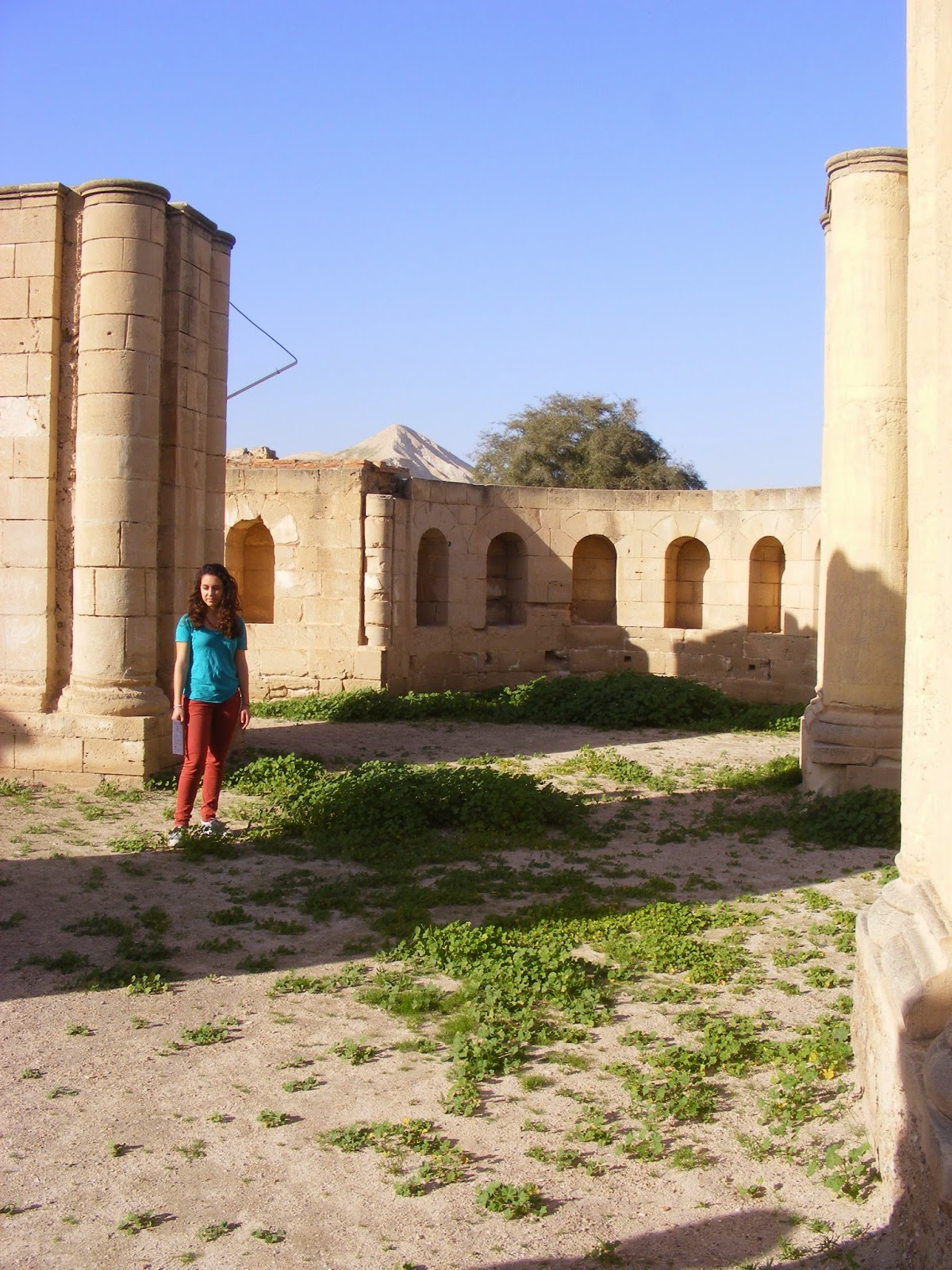
| Husham's Palace! An old Muslim palace from the Umayyad Dynasty, the first Islamic kingdom, begun shortly after the death of Mohammed. (Thus early 700s-ish A.D.?) |
D'aw the little camel out playing in the grass... We're in the middle of the local equivalent of spring here, so even the desert has a little layer of green, but also I think Jericho is generally greener than its surroundings.
While clearly a Muslim palace, there were crosses and other Christian symbols, statues with faces, and even a wine press. (Depictions of people(i.e. faces) and alcohol are usually forbidden in Islam.)
Reason 1) The Sassanian empire, the last pre-Islamic empire in the region, had destroyed a lot of stuff, including a lot of Byzantine churches, so the Umayyads were just using whatever building materials they found. Reason 2) The Islamic rulers clearly found nothing heretical in the fact that they had Christian symbols in their house and that they drank wine. Surprise: Religious people sometimes do things that are nominally forbidden in their religion. Bigger surprise: Rulers and elites of all shapes and sizes and eras sometimes operate by their own entirely separate set of rules.
 |
| Largest continuous and intact mosaic floor in the world. Incredibly beautiful and amazing, but unfortunately it's under a tarp and a thick layer of dirt because they're just trying to preserve it at the moment. Powerful piece of Palestinian history and Islamic heritage, currently buried because people can't agree how they want to set it up. |
 |
| Baptismal site at the River Jordan! I'm on the Israeli side, and that structure on the other side is in Jordan. Ostensibly Israeli soldiers will restrain you or someone somewhere will shoot you if you cross that yellow line. People in the foreground are Ethiopian pilgrims. |
.JPG) |
| Jericho. |
At a cafe outside of a monastery after a cable car ride on the Mount of Temptation (Where Jesus was tempted.)
Looking down from said mountain.
Somewhere up there in those rocks Jesus the 1st century Jew suddenly encountered a somewhat anachronistically Hellenistic depiction of the devil and had a very trying experience.
Monastery built into aforementioned and seen mountain!
 |
| At the bottom, looking up at the mountain -- cable car station and cafe in the middle, and monastery up a little and to the left. |
And here's a video of some YAGMs attempting to sing at/in front of the Sycamore tree where Zacchaeus the short tax-collector is said to have climbed the tree to get a look at Jesus.
Attempting more manageable and careful approach at blogging. Thus: Go on to upcoming next post to get to the important part! Although Jericho and its history is important too, duh. Palestinian heritage is sort of institutionally neglected in Israel, to the touristic advantage of the Biblical history.
They pick and choose which centuries of history they want to make legitimate, and then they sink billions of dollars of money into developing tourist infrastructure to emphasize that part of history and the narrative that goes with it.
The West Bank city of Jericho gives Palestinians a chance to finally give a little bit of a public voice to their usually downplayed and marginalized part of the immense history of this land, but unfortunately they don't have the money or the support or the infrastructure to develop and explore and present that. Thus: an expansive, old, and beautiful mosaic floor under a thick layer of dirt and tarp.
Subscribe to:
Posts (Atom)