Saturday, February 28, 2015

Jericho: City of the Moon, Fragrances, and a Frolicking Camel

Just a few weeks ago I spent a day in the city of Jericho, which spends its free time wrestling with a couple other Middle Eastern and Western Asian cities for the title "oldest continuously inhabited city in the world." (Apparently it's still pretty spry for an area that was playing host to groups of camping hunter-gatherers and early agriculturalists 12,000 years ago.)

It's a beautiful valley of a city, within sight of the murky yet lively Jordan River and the murkier and less lively Dead Sea. Also of great significance to Palestinian, Islamic, Arab, and Biblical history. Here's some pictures with somewhat descriptive captions, and then I'll move on to the important part.

(Full disclosure, this picture essay is actually sewn together from two different days I spent in Jericho.

So I'm lying to you.)


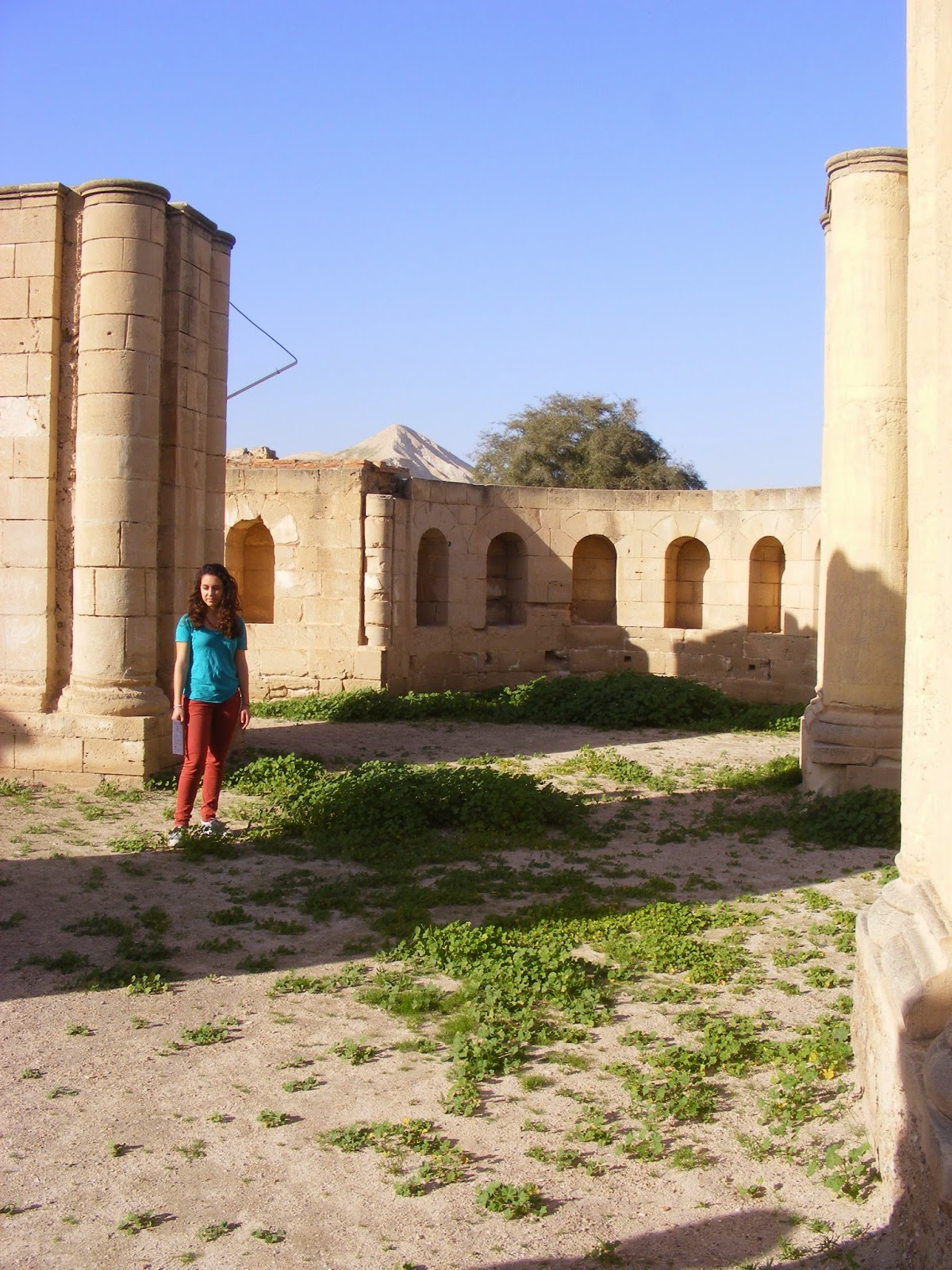
Husham's Palace! An old Muslim palace from the Umayyad Dynasty, the first Islamic kingdom, begun shortly after the death of Mohammed. (Thus early 700s-ish A.D.?)


 D'aw the little camel out playing in the grass... We're in the middle of the local equivalent of spring here, so even the desert has a little layer of green, but also I think Jericho is generally greener than its surroundings.


 While clearly a Muslim palace, there were crosses and other Christian symbols, statues with faces, and even a wine press. (Depictions of people(i.e. faces) and alcohol are usually forbidden in Islam.)

 Reason 1) The Sassanian empire, the last pre-Islamic empire in the region, had destroyed a lot of stuff, including a lot of Byzantine churches, so the Umayyads were just using whatever building materials they found. Reason 2) The Islamic rulers clearly found nothing heretical in the fact that they had Christian symbols in their house and that they drank wine. Surprise: Religious people sometimes do things that are nominally forbidden in their religion. Bigger surprise: Rulers and elites of all shapes and sizes and eras sometimes operate by their own entirely separate set of rules.

Largest continuous and intact mosaic floor in the world. Incredibly beautiful and amazing, but unfortunately it's under a tarp and a thick layer of dirt because they're just trying to preserve it at the moment. Powerful piece of Palestinian history and Islamic heritage, currently buried because people can't agree how they want to set it up.

Baptismal site at the River Jordan! I'm on the Israeli side, and that structure on the other side is in Jordan. Ostensibly Israeli soldiers will restrain you or someone somewhere will shoot you if you cross that yellow line. People in the foreground are Ethiopian pilgrims.

Jericho.


At a cafe outside of a monastery after a cable car ride on the Mount of Temptation (Where Jesus was tempted.)


Looking down from said mountain.


Somewhere up there in those rocks Jesus the 1st century Jew suddenly encountered a somewhat anachronistically Hellenistic depiction of the devil and had a very trying experience.


Monastery built into aforementioned and seen mountain!
At the bottom, looking up at the mountain -- cable car station and cafe in the middle, and monastery up a little and to the left.

And here's a video of some YAGMs attempting to sing at/in front of the Sycamore tree where Zacchaeus the short tax-collector is said to have climbed the tree to get a look at Jesus. 

Attempting more manageable and careful approach at blogging. Thus: Go on to upcoming next post to get to the important part! Although Jericho and its history is important too, duh. Palestinian heritage is sort of institutionally neglected in Israel, to the touristic advantage of the Biblical history.

They pick and choose which centuries of history they want to make legitimate, and then they sink billions of dollars of money into developing tourist infrastructure to emphasize that part of history and the narrative that goes with it.

The West Bank city of Jericho gives Palestinians a chance to finally give a little bit of a public voice to their usually downplayed and marginalized part of the immense history of this land, but unfortunately they don't have the money or the support or the infrastructure to develop and explore and present that. Thus: an expansive, old, and beautiful mosaic floor under a thick layer of dirt and tarp.


Friday, January 9, 2015

Snow Days in the Holy City


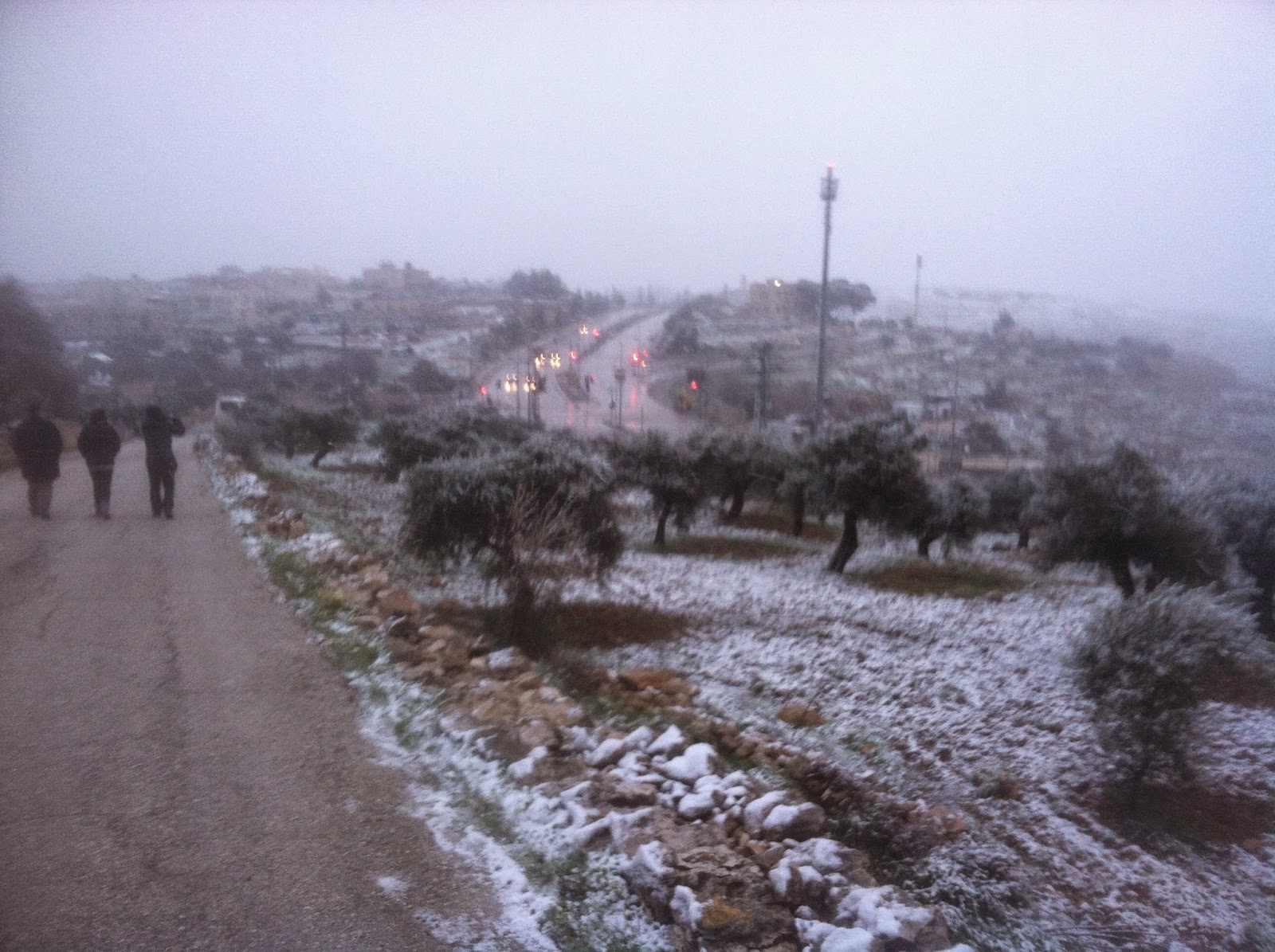
(Snow)storm Huda has hit the Holy Land. 

One day of storm wasn't bad at all -- the roads were clear and there were even some buses running -- but most people didn't even go outside and thus were safely allowed to assume that the outside world was a paralyzed wintry chaos. (They're really not ready for snow here.) 

A lot of it is the cold too, not even the snow. Below zero (Celsius) temperatures here are an excuse to stay home and do nothing (which I took advantage of for a bit). 

Even the muezzin singing out the Muslim call-to-prayer from one of the local mosques seemed to rush through it, like he just wanted to get back home before his toes fell off. (I'm pretty sure most of those are pre-recorded, but still. Fastest call-to-prayer I've ever heard. Moved through the words like a massive clump of snow abruptly dropping off a roof that was not built with precipitation in mind.)

The worst part was the two days before storm-time, in which the roads were constantly swamped by endless amounts of cars and people rushing here and there, sometimes to get a week's supply of groceries and sometimes to get home before anything started, and sometimes I think people were just driving back-and-forth panicking about everything because it seemed like the right thing to do. (A surprising amount of these behaviors are exactly what I'm used to in North Carolina.) 

Then in another half-day of clear roads I took a ride across town to Beit Safafa to meet up with other volunteers! Then we dropped back below zero and the city turned white. 

The most striking thing: In the two days before the storm the city seemed to come alive -- a usually subdued but active Jerusalem was suddenly full of energy and action -- a frenzied panic that was also sort of a relief because it was related to only the most apolitical part of the daily news broadcast. Then the city turned into a silent, white wasteland.

Pictures!


I select this caption to be the obligatory political part of this post. You see that very uniform-looking townish thing there? That's Har Homa, an Israeli settlement in East Jerusalem. One of many in East Jerusalem, but -- what's worse -- is it's many twins throughout the West Bank. Looks very innocent, densely suburbish, heavily subsidized housing, but that seemingly bland and offenseless exterior masks the fact that it's illegal according to international law (and according to every country besides Israel), and it serves as a reminder of a broader Israeli governmental campaign of splitting up the West Bank with scattered outposts of illegally established neighborhoods so as to make a potential future Palestinian state less and less contiguous and less and less viable. And as carefree and fun as snow currently feels in Jerusalem, I feel obliged to keep at the back of my mind the hundreds of thousands in Gaza displaced by the conflict this summer, now struggling to find shelter and warmth. But as I see it, if we (Michael, Palestinians, Israelis, humans) can't find moments of joy and light in even the darkest of times, then we'll never be able to muster the hope and initiative to de-demoralize ourselves and really do anything. Thus snow. Which somehow makes even the darkest night seem eerily cheerily bright through the miracle of refraction.


Snow-capped cacti!

Later that night we headed back out to really see what Jerusalem had to offer as far as snow quality/quantity is concerned. And just as we were getting started on a small snow creature, we were ambushed by al-shabab! 

("al-shabab" in Arabic means "the youth," or "the boys," and is generally used to refer to trouble-making sheniganeering younger males. But it can also be a neutral term, or even a term of affection -- all of that seems to be mixed up in there.)

What followed started as a playful snowball fight, gradually escalated to something partially unpleasant (largely because one shab was about 10 years older and threw twice as hard as the other shabab), and then coasted clumsily into something more ridiculous and mutual for about 20 minutes (i.e., my hands were frozen so instead of throwing snowballs I just jumped and dodged around -- pretty soon the kids stopped throwing too and we just slid around and charged each other repeatedly like blind penguins trying to body check a defenseman in a Hurricane's game. Glorious.)

Then a dad insisted that the kids leave well enough alone, which was probably pretty good timing because I couldn't feel my feet anymore.


Sorry I don't have any pictures of myself, I'll work on that.

Saturday, December 27, 2014

As I Wrestle With History In A City Where There's Really Not Much Else


The air is so thick with history here -- you can almost choke on it if you're not careful.

I work around the corner from the Garden of Gethsemane on the Mount of Olives, which is said to be where it will all start/end when the end of the world gets rolling (That's why there's so many cemeteries around it -- gotta be first in line to be resurrected you know.)


The raised area in the back is the Mount of Olives (the middle and lowest of the three towers in this picture is the Church of the Ascension, which I pass by on my short walk to lunch.) 

 I don't think about it very often though -- the air of history there tends to be more subdued, only manifesting itself in sporadic groups of tourists interrupting my path to the cafe.


 Just the other week I was at the Lutheran Church of the Redeemer in the Old City, waiting for a friend to get off work, when I decided to walk the 100 feet over to the Church of the Holy Sepulcher, the traditional site of Jesus' death and burial, and hang out for a little while. It's a lot more crowded and tense than the Mount of Olives.

--Not least because the various churches represented here (Catholic, Greek Orthodox, Armenian Orthodox, Ethiopian Orthodox, Syriac Orthodox, etc.?) can get pretty ornery about seemingly insignificant things. (Fist fights between priests of opposing factions are not altogether unheard of or shocking occurrences.)

But I guess if you devote your life to this stuff and spend the majority of your many years of existence living near and working in this one specific building, you might get pretty uptight and specific about a few things (e.g. how often the rock of Golgotha should be cleaned, to what extent the Greek Orthodox can put their weird gaudy gold candles everywhere, whether or not the Syriacs are allowed to renovate their burnt out chapel, the list goes on).


I'm currently standing on the hatch used by the church fathers to enter Jesus' tomb every once in a long, arbitrarily decided, traditionally delineated calendar tenuously agreed upon by the various churches. 

Inside that little alcove is a hole through which you can touch the rock of Golgotha, upon which Jesus was crucified and around and on top of which this church was built. That figure to the left is a priest of some variety of Orthodox (Cause no self-respecting Catholic would condone those garish bejeweled decorations) promptly stepping in for the periodic Windex-ing of the glass for viewing the rock and the wetwipe-wiping of the blessed armhole through which pilgrims can touch the rock. I felt incredibly blessed to bear witness to such a solemn and important ritual.

 Here the history is a little more palpable. There's the heavy smell of incense, the dark, germy rocks that had contact with Jesus somewhere along the line, and the cold, rough crosses carved into the stone walls by crusaders who hacked-and-slashed their way to the Holy Land and into Jerusalem so many years ago.

You feel it in the obnoxious throngs of tourists of all shapes and sizes and origins, and you feel it in the tension between the priests as they go about their meticulously structured routines and mind the strictly demarcated boundaries between denominations and sects. 


But that's just the beginning. I haven't even started on the history of Judaism and Islam in this place, and there are a couple more whole worlds of history outside the realm of religion too.

This is just a small taste of the backbone of history underlying and looming over this beautiful, complicated place. Thousands of years of Roman and Islamic and Crusader and Turkish and so many other histories overlapping and undergirding each other.

Then there are histories that define everyday life here more than any others. There is the history of Jews, filled with persecution and defiance, blood, loss, and exile in the face of an always stronger and oppressive power -- and there is the history of the Palestinians, filled with dispossession and resistance, death, fear, and pain, always at the mercy of some grander empire or ruler.

The air is thick with all of it mixed together, a thousand different stories remembered and countless lives touched and scarred forever by the past and now the present. The sour taste of endless cyclical violence and a blinding fog of irrational fears and hatreds. It fills the air and all of our lungs, and then it sits on the city, pinning it down beneath the tremendous weight of memory. 


I appreciate the history; I enjoy learning about Jesus' life and what we know about it. But I can't seem to ever be touched by it. No matter how often I walk the Via Dolorosa, the Way of Pain, the way Jesus walked under the weight of the cross, I can't seem to find meaning in it for my spirituality today. I don't get anything out of it.

I see the people around me as I walk and I can't make the disconnect. I can't find the beauty of this history because I can't see it apart from the people here now, who live with the weight of all this accumulated history on their backs day in and day out, year in and year out.

This is the history that brought about the reality of today: occupation, fear, deprivation and indignity -- and this is the history that makes the future look like more of the same: distrust, unrest, crippling stalemate and painful cycles. The accumulated weight of history keeps us in the past, and forbids us from progressing into a future of justice and peace.


It's not all of history that's to blame! And there's hope there too. But we have to unearth it. We have to keep walking the Via Dolorosa, the way of suffering, the way of weight -- until we find a way to redeem it. To reconcile it with the world I see around me. To bring this ancient history back to life and full communion with life as it is lived here, and free all those here burdened by its weight.


But that just got a lot more high-minded and rambly than it probably deserved to be. (And confusing because history means so many different things) This is as much a personal process as it is a hypothetically region-wide or possibly global one. I'm sorting through these histories, finding this weight, trying to reconcile all that I see and all that I know and all that I believe. I'm trying to find Jesus here.

But once I say that it seems pretty silly.

All I really need to do is look up. Those people aren't just watching me as I meander my way across Jesus' historic steps through the Old City and up to what is now the Church of the Holy Sepulcher, built on the rock of Golgotha. They're walking it too, and they've been walking it since before I was born.


Sunday, December 7, 2014

I Bought a Coffee Mug Today. It Was Made in China.


What did most people occupy their lives with just a couple hundred years ago? Well that's easy, it seems to me like the majority of people would spend their days busily preparing and producing material goods, like food (totes obvi) or useful and important tools for living like chairs or clothes or any of a wide array of different instruments for making coffee.

Then we got all industrial and now most of those things are mass-produced -- lower costs, less time investment, and often better quality (with the primary loss as far as the actual good is concerned being only that EVERYONE'S EVERYTHING LOOKS EXACTLY THE SAME.)

Also there's no "love" or "compassion" or "the least bit of human contact" cooked into my twinkie or sewn into my polo, but whatever. 

But wait! That's a lot of displaced employees. People can't just sit and lazily enjoy the fruits of industry their whole lives! Money in modern economies doesn't work that way, and people seem to rapidly lose dignity and the capacity to not hate every aspect of their lives when they don't have something like work to do or the ability to "provide" in some sense. Plus, we spread like kudzu and cane toads, so there's a lot more of us now. What do all those people do?


Well it turns out a lot of them sell souvenirs.


"Prominent"

Which is kind of ironic -- or something -- because they're either the last remaining outlets for the actual handmade goods, or they sell the worst of the worst of the kitschiest, cheesiest, most mass-produced and uniform of the industrial goods -- and then attempt to pass it off as handmade.

That can be a good job, and it can be an easy job -- but it probably depends a lot on where you are, what the economy and political environment is like around you, that sort of thing.

If you're one of umpteen billion identical shops in the Old City of Jerusalem, and you happen to reside in a country where tourism and thus your income are entirely contingent on the thoroughly volatile geopolitical situation, you might have a pretty rough go of it.

And it only gets worse if you're in, say, Bethlehem. (Because giant concrete walls and security checkpoints might not deter violent extremists or contribute to political solutions, but one thing they sure are good at is scaring away tourists.)

Less than a day after Jesus changed water into wine: Local resident: "You know what, I bet if we charcoal that onto a crude 1st century equivalent of a postcard, goshdarn-it, people will buy it!"


So when it comes down to it, if you're forced to choose between A) lying to tourists' faces and trying every tactic in the book to trick or simply guilt them into buying a small coffee mug with a print of a mosaic on it for five times the standard sell price or B) not feeding your family -- then the choice is not a difficult one. 

And as far as selling out your conscience, soul, and intrinsic human dignity go, there's a lot lot lot lot lot lot lot lot lot lot worse you can do "just to get by" than trapping a tourist in your shop with free coffee and inventing stories about the "people" who "made" this factory-mug by hand (while you discreetly tear off the price tag from the bottom of the mug). 

And there's space for redemption and honor in there too! Because every friendly welcome into a shop and offer of coffee or tea doesn't have to be an empty commercial gesture. You can really touch people's lives that way! (Which I guess is part of the exchange, if we want to look at it economically.)

And there's some sort of cultural/national pride and empowerment thing that can go into that -- as long as you don't feel like the symbols of your heritage are cheapened to the point of meaninglessness by being mass-produced in foreign factories and aggressively hocked at foreigners.

But yeah. I can't imagine it feels good to lie to tourists every day, even if the hospitality is always genuine. But that's life -- it's out of your control! You do what you gotta do! No matter how it makes you feel about yourself afterward. 


Disclaimers: I do not intend to cast shame or color perceptions of either souvenir store pictured.

(They're just the ones I have pictures of.)

(Also if shame was cast on any individuals anywhere then I did something wrong.)

Also for the record: I did not overpay for a coffee mug. However, haggling was a long, arduous process.

And good language practice.   


Speaking of other ridiculous consequences of the post-industrial age... This was the most relevant picture I found before I realized I had pictures of actual souvenir stores. Jerusalem's Bus Stop Graveyard.


Bibliography:


blah blah something about service economies

gross generalizations

Anecdotes

probably Wikipedia


Friday, December 5, 2014

Out of the Mouths of Infants: Grunts and Incomprehensible Chattering

(Leaving out pictures and names for privacy reasons cause kids, sorry. But hey! Look forward to my next newsletter! And if you want that and aren't on a list for it/you want past newsletter, send me an email at miked3592@gmail.com)


I've worked with kids before. I'm by no means a stranger to playing with children, although the ones I'm playing with now are a little smaller than I'm used to. Being silly and playing games and dealing with tantrums and accidents isn't totally new to me, although it's true I am generally accustomed to children who can, given the proper space and time, successfully dress themselves with minimal assistance.

So that's new for me.

And as I sit here and reflect, holding crayons still as my 3-year-old companion meticulously peels the wrappers off like a conscientious matron polishing silver, I realize the daily joys and tribulations and oddities I'm facing here at my kindergarten/preschool/daycare hybrid in East Jerusalem are pretty irregular, actually. It's an environment both uncannily familiar and ridiculously different.

There's the age range, from nearly one all the way to five, which leads to some pretty silly interactions.

And then there's that whole language thing. Yikes.

There's a lot of overlap in comprehension with the kids, because if someone shouts "GET DOWN FROM THERE" at you enough in any language, you're going to understand it eventually. But to really effectively communicate fully with all these kids, you need to be competent in Arabic, English, German, and maybe Czech. That's not to say those are all the languages different kids there know, but it's enough to get by.

So in a single work-day I end up speaking a blurred, clumsy mix of English, Arabic, Norwegian, German (in steeply descending order of my actual competence), and sometimes even some Spanish by accident. One girl knows Italian, so Spanish is close enough, right? The crayon girl knows Norwegian, English, and Arabic, so I try to speak Norwegian to her -- just for the fun of it, and it grabs her attention a little better (you don't hear Norwegian very often here.)

There's a thick mix of local Palestinian children and children of internationals working with various NGOs and such -- not to mention a lot of mixed families that makes it even harder to spot the internationals versus the locals. 

I get a lot of chances to practice my Arabic though, because there's very little pressure when speaking to a 3-year-old. If I don't make any sense, maybe they just look at me funny -- which is whatever, because they were already gonna look at me funny. Or maybe they're crying about falling off the slide or I'm hurriedly carrying them to the bathroom -- regardless, they're not going to call me out on my bad grammar.

And the older kids even help teach me! Well, to an extent.

Some of them chatter endlessly and adorably to me in Arabic, not really caring whether I understand or not, while some speak Arabic but for some reason or another decide to communicate mostly in grunts. One particularly eloquent grunter likes to point to things and teach me vocabulary, but I know enough Arabic to know he's usually wrong. Maybe he's just messing with me?

Another girl is always super pumped to teach me more words, but whenever I point at an object and ask "shu hay?" she just tells me what color it is.

Most of the time though I just feel bad that I can't understand more of the incessant rambling and mumbling of the small Palestinian children as they play and wander about indulging their wild and vivid imaginations, beautifully unrestrained by all that "reality" and "knowledge" and "physics" that they'll pick up on as they continue growing. If only I knew a little more Arabic, that world of play and magical possibility wouldn't be so closed to me...

But then I hear the Canadian kid climb onto the slide and exclaim to no one in particular something like "You're a tomato -- mommy where fardinar!" And suddenly I feel a little less bad about my lack of comprehension.


Sunday, November 9, 2014

Lutheran Pride in the Religiousest City on Earth

"This life therefore is not righteousness, but growth in righteousness, not health, but healing, not being but becoming, not rest but exercise. We are not yet what we shall be, but we are growing toward it, the process is not yet finished, but it is going on, this is not the end, but it is the road. All does not yet gleam in glory, but all is being purified."

Martin Luther

(Photos by Danae Hudson)


EXPOSITION

So October 31st was Reformation Day. If you are of the Protestant persuasion, perhaps you had a special service of some sort, or maybe you'd just halfway noticed an increased incidence of Martin Luther quotes popping up on bulletin boards and newsletter-tables-of-contents. Or maybe you had no idea, that's also very possible.

When I was at UNC, we Lutheran students celebrated by donning our Halloween costumes and taping the 95 theses to the door of the Catholic student ministries building. So at least we celebrated it?

Here in Jerusalem though, Reformation Day is a pretty big stinkin deal. Perhaps because it's not majority Protestant Christian like America, and thus the ethno-cultural-religious significance of the holiday is a lot more apparent, and the effects of that initial act of "Reformation" (the whole nailing grievances to a church door thing) are consciously felt a lot more often?

     TANGENT

Hard to say for sure. Religious identity in America in general isn't really super salient or talked about much, so I guess it'd be doubly unusual to have some sort of "Protestant" or "Lutheran Pride" event.

Whereas here in the Holy Land, religious identity is proudly and assertively on display, perhaps only second in its significance to the behemoth that is "national identity," which just happens to be somewhat angrily and confusedly inextricably intertwined with the question of religious identity -- WHICH of course brings us to the fascinating question of the place we and Palestinian Christians occupy in this tremendous regional Palestinian/Israeli conflict that seems so strikingly to be divided across ethno-religious lines in regards to which we are not clearly situated, so we should just drop this question before it takes us further off topic.

    GETTING TO THE POINT

So in the shadow of a tense, conflict-ridden Friday in Jerusalem (just the latest Friday in a couple consecutive months of escalating pressure) and the first gloomy, dark, wet day I've seen in my whole two months here, we Lutherans descended on the Old City, assembling at what has become my home church this year: The Lutheran Church of the Redeemer, founded in the 1800s by Kaiser Wilhelm and now home to a motley mix of congregations of different languages and nationalities.

Redeemer on your average Sunday is already an exciting and fascinating smorgasbord of different peoples and voices and nations sharing the space and schedule-dancing around each other, but this service was something else entirely. (Smorgasbord is only appropriate because of the strong Scandinavian influences at play throughout the church space. A mixed buffet including meatballs and cabbage rolls would not be entirely out of place.)


The liturgy cycled spontaneously back and forth from Arabic to English to German, and sometimes all three at once. (And the prayers of the people took that and kicked it up a notch with some Dutch, Norwegian, Swedish, Finnish and Danish.)

A whole parade of presiding clergy marched in at the beginning of the service, with not only Lutherans but Anglicans, Mennonites, United Church of Christ priests and probably Methodists, hailing from not just America, Palestine and Germany, but Denmark, Sweden, Finland and the Netherlands.


 And you see those guys in hoods and the other fancy looking patriarchal looking figures around them? Well, they're the patriarchs. Mixed in there you've got Ethiopian Orthodox, Armenian Apostolic, Roman Catholic, Greek Orthodox, Coptic Orthodox, and Syriac Orthodox (You can tell by the hat-shape.) Cause no Jerusalem Reformation Service would be complete without representatives of every other Jerusalemite Christian denomination falling asleep in the front rows and getting tipsy on free reception wine.

As you can tell, it was a pretty huge deal!

Although... it wasn't really the most elegant service.

Actually, it was downright messy in parts, if only because of the conflicting bulletins, the communion riot, and the whole thing where it sounded like mildly syncopated, throaty garbage when we sang.

"A Mighty Fortress is Our God" was a clumsy linguistic tangle of incomprehensible overlapping mumbling, and the Germans always seemed to have more words than us. The Lord's Prayer was more of the same but quieter and with less organ.

But what matters is that we were there. The wild, eclectic mix of peoples of all different backgrounds and origins and walks of life -- and the wild potential, the possibility that this joyous and messy pluralism represents.

We were gathered there in the midst of turmoil to celebrate Reformation. Reformation in the past and Reformation in the now.

Religion can be an escape, a way out of the circumstances of the world. Like a cornered animal it turns fatalistic and apocalyptic, turning within itself like the hedgehog of cosmology showing its spines.

But even if we had wanted to escape from the worldly circumstances bearing down on Jerusalem in general and the Palestinian Christian community in particular and just mindlessly peacefully celebrate for one night, that's not an option here.

"Upon your walls, O Jerusalem, I have set watchmen; all the day and all the night they shall never be silent," began the first reading, and the chanting drone of the Muslim call to prayer filtered into and through the church, filling the silences between words and sentences with the melodic reminder of the city around us.


It took me back, just hours ago, to my trip across the city earlier that morning. The Israeli government, in response to growing tension and violence, had completely shut down access to the Al-Aqsa Mosque and the Al-Aqsa compound for the first time in I think probably decades.

The center of East Jerusalem, around the Old City, was swamped with heavily armed Israeli security forces. Positively marshy with martial enforcement. Like a bog of bogus political logic. Did I mention it was a really unseasonably gross and wet and hazy day?

I waited at a bus station for nearly 45 minutes (45 minutes longer than I normally would've) because the buses just couldn't get there. But that wasn't because of the security.

Lined up in front of one of the Israeli barricades were dozens of Muslims, young and old, lined up in even rows. They couldn't get to Al-Aqsa (the third holiest site in Islam), so they prayed at the barricade, kneeling down on carpet squares from home, cardboard they'd found on the way, or just on the wet dark street. They prayed, they bowed, they worshiped, they milled about a bit, and they went home.


It was profound and powerful and vaguely intense. I anxiously watched from the impatient bus line, satisfied by the reasonable distance between me and the inevitably political act I was witness to, but nervously plotting an escape route just in case.

I still don't know what to make of it. There were feels but I can't untangle them enough to name any and the whole experience thoroughly resists effective processing, let alone blog-worthy metaphorizing.

What I'm trying to say, (or at least what I'm going to say), is that the situation here is tense and tragic and painful and obscenely implausibly complicated. The only thing that's clear is that something has to change.

There's a lot wrong here, and there's a lot wrong in the world, and there's a lot wrong in "the church," whatever that means, and there's a lot wrong with us, whoever that is.


So in lieu of an escape, and with me unable to process enough to give you an adequate emotional conclusion, I'll offer you what I then received in that church in the Old City on Reformation Day, with so many different people coming together to share.

It was delivered in Arabic, but I'll be nice and give you the English.

"Then he began to speak, and taught them, saying:
'Blessed are the poor in spirit, for theirs is the kingdom of heaven.
Blessed are those who mourn, for they will be comforted.
Blessed are the meek, for they will inherit the earth.
Blessed are those who hunger and thirst for righteousness, for they will be filled.
Blessed are the merciful, for they will receive mercy. 
Blessed are the pure in heart, for they will see God.
Blessed are the peacemakers, for they will be called children of God.
Blessed are those who are persecuted for righteousness' sake, for theirs is the kingdom of heaven.
Blessed are you when people revile you and persecute you and utter all kinds of evil against you falsely on my account. Rejoice and be glad, for your reward is great in heaven, for in the same way they persecuted the prophets who were before you."


Hence, Reformation. 


I'm not much of a "quote" person. It feels more lazy than anything else most of the time. But there are some things I just can't say. 


"This life therefore is not righteousness, but growth in righteousness, not health, but healing, not being but becoming, not rest but exercise. We are not yet what we shall be, but we are growing toward it, the process is not yet finished, but it is going on, this is not the end, but it is the road. All does not yet gleam in glory, but all is being purified."

Martin Luther


"We are workers, not master builders; ministers, not messiahs.
We are prophets of a future not our own."

Oscar Romero


Follow this link for the sermon, delivered by the excellent Pastor Carrie of the English congregation.

AND HERE FOR MORE PICTURES


Sunday, October 12, 2014

One Hot Day in Super Land: A Glimpse of Peace in a Cheesy Amusement Park


People keep asking me questions about politics, violence, and ISIS (or as it's called in Arabic: "da'esh." The apostrophe here meaning that all immediately surrounding vowels should be pronounced like a growling cat mid-strangulation).

Which I guess is understandable, because I'm in Jerusalem which is in the Middle East and both of those proper nouns carry a lot of baggage and crop up in the news on a regular basis. But instead of any of that I'm going to talk about fun and silly things like amusement parks because that's what I'm actually doing.


So I'm living with a wonderful intern/associate pastor/vicar type character named Fursan, and he runs the local church's youth groups -- which means I get to tag along to all sorts of things! And for some of our break from work/school this last week (Because of the Islamic holiday Eid al-Adha), Fursan and the middle school/high school/young adultish youth group decided to go to a magical magical place called Super Land.

So I got up reasonably early on Monday morning, had my standard breakfast of cultured milk fat, jelly, and coffee, and prepared to ship out for Super Land. I of course had very little idea of what on earth Super Land was, but I was soon to find out. After waiting an unnaturally long time for everyone to gather and the bus driver to show up, we got going.
 
Outside the park: Clean, manicured, and potentially a *few* native trees.
Also: Lines. Already lots of lines. Deep sense of foreboding kicks in right about now.

Not too long of a drive, probably less than an hour. Super Land is west of Jerusalem, near Tel Aviv, in a town called Rishon Lezion -- if that means anything to you. And what did I find there in Super Land, you might ask? Well, amusement park stuff, duh. Exactly like an American amusement park except it was all in Hebrew and the demographics were a wee bit different. Here's some more photos!


It doesn't look very crowded in this shot, but yes. It was crowded. This just looks relatively empty cause people aren't allowed to form lines in the middle of the walking areas. Anywhere they were allowed to form a line, it got pretty dense with humanity.


Hebrew! Various warnings and instructions variously bolded and highlighted and underlined and ovaled and "!!!"ed. 

The language situation was a little weird. Coming out of East Jerusalem, where most signage includes Hebrew, Arabic and English, and where most people speak Arabic, if not also English, it was a little weird coming into Hebrew-Heavy Super Land. Although Arabic is one of Israel's two official languages, it was a bit of a struggle. There were a few employees who spoke Arabic, but most of the time we all had to rely on the Israeli clerk's stumbling English, and sometimes I had to rely on the twice-removed mediation of my Arab companions with their haltering bits of Hebrew skills. (That felt weird.)

Not that I would've been able to understand if everything had been in Arabic? Whatever. I spent most of my day just trying to soak up language ability. I was the ajnabe (foreigner), the ward of the group, suddenly removed from the context I'd just begun to learn how to navigate and thrown into a different one (that looked oddly familiar in a kitschy, American sort of way).

And even though Fursan and the motley assortment of middle school, high school, and college kids were in a vaguely foreign environment themselves, they took care of me. Some of the younger ones used the only English they had to verify that I had fun after every ride, and all of them seemed to feel responsible for making sure I ate and didn't get lost on my way to the bathroom.

(We could note here also that these kids don't know me super well, and I'm not especially communicative, what with the semi-permeable language barrier membrane that I'm slowly but steadily creating pores in for me to peer through or whisper-mumble something half-articulate and only partially incorrect through. Pretty humbling.)


Some of my young Palestinian Christian companions getting off of that-one-ride-where-the-boat-spin-swings-you-around-in-a-circle. Like most things at Super Land, it brought me back to state fairs in North Carolina, and bringing with it, of course, all that attendant anxiety about the safety of those shoddy fair rides. Some things never change.

Here's the Super Land mascot-type-character. Kinda scary. And I don't get it.


They have bumper cars here too! In listening to Arabic conversations going on around me, I'm often limited to just understanding the occasional word here and there, like "peace," "shoes," or any of an extensive range of prepositions, but I now have reason to pride myself on being able to deduce what ride we're going to before we get to it. Cars (Sayyaraat) is bumper cars, chairs (karasi) is that one thing with the chairs, and trains of death (Qataar al-mot) is roller-coasters! I have not been able to corroborate that roller-coaster translation anywhere online since my trip to Super Land, but I stand by it.


Friends! Waiting in line!

Apparently the Middle East has bumper cars too. Who knew?

And these are the chairs I was talking about earlier. The ones that pick you up and swing you around like a sepia-tinted Kansas twister. I remember *loving* this ride as a kid. Not quite sure why. I think it just felt very high and intense, but I was firmly in a chair so it felt safe. High point (haha!) of many a yearly family trip to the state fair. That and fudge. Family pictures were eh.

Kablam! America but in a desert ecosystem! Which makes you really start to question the logic of all the water rides.


A Jewish orthodox family trying to read the map. It was a pretty small park, but I gained very little in terms of confident navigating ability during my day there. It was like a miniature Holy Land equivalent of a local state fair trying to be Six Flags.
Muslim woman wearing hijab, apparently texting and trying to find her friends. They're probably stuck in a line somewhere.

Muslim man carrying an overexcited child as they watch people do that crazy fly up in the air and back down thing.


Anyways, it was a good time. And just like fairs and amusement parks and cheap country buffet restaurants in America, Super Land gives you a glimpse of a society at its most united. No matter the race, the socio-economic background, the religion, ethnicity, or political disposition, everyone comes together. Arabs, Israelis, Palestinians, Jews, Muslims, Christians, Arab-Israelis, Jewish Israelis, Palestinian-Arab-Israelis, Palestinian-Arab-Christians-who-live-in-Israel, etc. etc. and probably many other religious minorities like Druze and Baha'i that I can't confidently identify or spot in a crowd. (And many other fancy and complicated and unexpected ways of putting together the many descriptors I just listed above). 

They were all there. And they weren't there to voice their grievances, legitimate or quasi-illegitimate, they weren't there to cause tension or to politicize or to protest or to rationally express the myriad ways they've been wronged or to irrationally announce their radical response to whatever it is. 

They were there to have fun. To live their lives. To give their children an exciting day of rides and games. To stand in line with their family for the bumper cars. To wait in a queue with their friends for the fancy chair ride. To patiently pass the time in semi-organized linear segments of people to spend less than 5 minutes on a "train of death" with the people they love most in the world (plus that weird ajnabe they're being nice to).


And all that is not to say it's perfect unity, total peace. Of course not. And if it were it'd be a farce, a bold-faced lie of an anecdote-turned-metaphor. The tensions are still there. It transcends the conflict but it does not hide it. 

From the language discrepancies to the (drunk?) Arab man who tries to start a fight in line for the log-flume, to the Israeli staff woman screaming at every other person in line about how seating works on the log-flume (often in what is *at least* their second language), to the Palestinian youth who cut in every line until an older man who can command respect tells them to stop -- to the countless people who simply aren't there because a dividing wall, a fee, and endless webs of arbitrary, convoluted, explicitly racist bureaucratic processes are keeping them away.


 (And that's for West Bank Palestinians -- Families in Gaza just have a military blockade in the way.)
The shaded middle-left area is Israel, the blue line is Jerusalem, and the solid orangish line is the dividing wall. I'm in the ambiguous part of Jerusalem that's "Israel?" but not Israel. The wall is sometimes a huge concrete wall and sometimes just a fence, but to cross it you have to go through a checkpoint. For West Bank Palestinians to cross for short visits they have to apply and pay and wait for it to be processed, and then it's still subject to the whim of whoever processes it. And there ends the educational bit for today. This map came from http://t-j.org.il/JerusalemAtlas.aspx , go visit for other cool informative cartography.

And anyway we don't need something like amusement parks to hide the conflict and tension for us. Where is God in that? What it does is something far more significant: It allows those peoples to come share a space, flaws and all, and explore and exhibit their common humanity despite and through and in the midst of those tensions.That's where God is. In redeeming that space and those lives and giving us a chance to be a part of that.

 Because kitschy overpriced "fun" and waiting in lines is something the whole world can enjoy!

Given the territorial access and economic means, of course.

Which is a pretty huge caveat.

But yeah.

It's still something.